In Peggy McCracken’s “Only Women Bleed”, she makes a point
to say there are multifaceted views of menstruation in medieval literature. “… the exploration of the value of menstrual
blood in medieval culture allows us to perceive that menstrual blood can be
seen as both polluting and healing, as a sign of fertility and as a sign of
death, or as a curse and as an ingredient in a love potion…” (6). However, the
negative connotations of menstruation seem to outweigh the positive, especially,
when men and women’s bodies or blood are compared: “semen was seen as a pure
form of blood that demonstrates the superiority of the hot, dry male body over
the humid, cold female body” (4). This view proposed by Aristotle, influenced
many medieval writers, thus resulting in the idea that women’s bodies and blood
are to be perceived as inferior. Menstruation making them more vulnerable, and
more unlike to their male counterparts: “Menstrual blood, like other bodily
wastes (urine or feces), is anomalous, ‘out of place’” (5). Many medieval
discourses refer to menstruation as “a polluting blood, a feature of the
imperfect female body whose imperfections mirror the perfections of the male
body”, ultimately, “men’s blood is more valorized and women’s blood more
marginalized” (20) in majority of medieval literature and therefore, creates a negative
stigma of menstruation while adhering to the continuation of misogynistic views.
While
reading this article I decided to find modern day examples of the menstruation/period
stigma. This menstrual taboo is very much alive in today’s society.
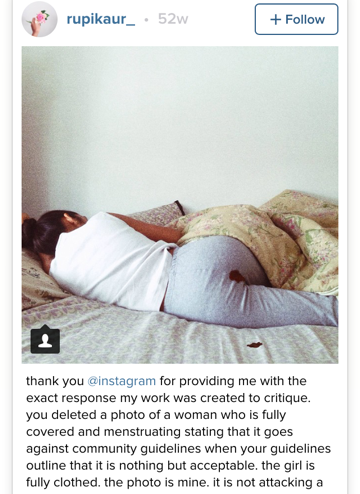
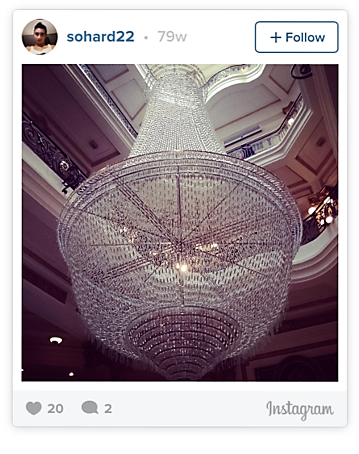
These pictures above are just recent examples that reiterate the stigma of periods. On the left is a picture of a student, Rupi Kaur, who decided to make the ‘menstruation taboo’ as a theme in her college photo project. When she posted it on the social network, Instagram, it created a lot of controversy. At first it was deleted by the network because it did not fit the “community guide lines”.
The picture on the right is called “The Bride”, a chandelier made
out of 25,000 tampons done by Joana Vasconcelos. She tried to include her work
at the Palace of Versailles, but it was banned because it was referred to as a “sexual work.”
Even in the political
realm, Hillary Clinton was negatively associated with menstruation:

The attitudes against women and their bodies in medieval
literature can be applied to contemporary times. Periods and menstruation
is still a subject that alienates women.
So, one question remains: how different would the views on
menstrual bleeding be if men had periods?
https://www.globalcitizen.org/en/content/if-men-had-periods/
