Showing posts with label man of law's tale. Show all posts

Monday, March 28, 2016

A Human Nugget: The Potentiality of Women's Bodies in Medieval Times through The King of Tars and Two-Egg Theory


In the tale of The King of Tars, a Christian woman and a Pagan sultan are wed and produce a monstrous child: limbless, a round of flesh with no blood or bone, no eyes or nose or other facial features, and stone cold dead. While the tale goes on (spoiler alert: converting to Christianity fixes everything), viewing the scene of the child's birth and existence alongside classical and medieval thought on the potentiality of women's bodies can, in a way, explain everything. A major feature in Aristotle's thinking of conception and women's bodies is that a child's creation required man's sperm, the uniqueness and provider of a soul, with the mother acting as a passive vessel. A woman's body in this Aristotelian concept is additionally the provider of a physical potentiality of a child -- which is a logical jump because a period is a (failed) potentiality to create life. Because this potentiality alone cannot produce a life, a period exists; but add semen to the mix, and poof! Automagically a baby is born (or so says medieval thought). However, Aristotle is not the only philosopher whose contributions make it into The King of Tars -- this is where Galen and his Two-Seed Theory comes into play. Two-Seed Theory is essentially assuming that a man's seed (sperm) and a woman's seed (ovum) fight a battle of epic proportions, and whichever emerges victorious is the parent whom the child shares its appearance. With a combination of Aristotle's view that woman is simply a physical matter-producing vessel, representing only the potential for life, and Galen's idea of the Two-Seed process wherein either parent's appearance could become the child's basic structural pattern, one option is that because a woman is incapable of producing a body with a soul or any unique features they are blessed with a human version of a chicken nugget. Granted, this not only would support Aristotle's idea of woman being unable to create life, but also follow many other medieval beliefs about where the blame of an imperfect baby stems from: the mother. In our previous text on the Man of Law's Tale we discussed that the state of an imperfect child is considered entirely the fault of the mother in medieval thought, due to either the moisture level of the womb, the temperature, the (im)purity of the mother's thoughts, or any number of reasons. One argument that could be made is that because the mother is naturally flawed, even if she has the correct moisture, temperature, and pure thoughts, she still produces offspring with a major deformity because her "seed" was victorious in Galen's understanding, but was unable to produce a normal infant because such a seed is only a potentiality without the aid of a man's sperm in Aristotle's understanding.

Of course, as the main character is a Christian woman, everyone else needs to just convert to Christianity and everyone will live in a magic fairytale land, happily ever after. Jesus will shed tears of rainbows and bless the nugget as the king of all nuggets, dubbed Nugget McDonald, ruler of McDonald Land.
                        
Nugget army of King Nugget McDonald

Thursday, February 18, 2016

“There are fights no sword can win”: Catelyn and Sansa Stark as (Better) Representations of Medieval Noblewomen

If there’s anything A Song of Ice and Fire (and Game of Thrones) have, it’s a lot of characters. Enough to justify 25+ page appendices at the end of each book, and infographics across the internet for show-viewers. 

I wonder if GRRM has a wall of his house devoted to keeping track of this stuff.
Thus, both series include a range of female characters (though the narrative treatment of the women arguably doesn’t vary that much), fitting many roles familiar to us as so-called ‘strong female characters’ (I’m setting the critiques of that idea and those portrayals aside for the sake of this post).

Among the women in the series are many fan favorites and favorites-to-hate, like Daenerys Targaryen, Cersei Lannister, Brienne of Tarth, and Arya Stark. Daenerys and Cersei mirror one another in their use of marriage and childbearing to claim power in their own right—Daenerys as khaleesi of what will become her own (small) khalasar, and Cersei becoming Queen Regent over Joffrey, followed by Tommen. Brienne and Arya take the opposing route: rather than using their femininity to work around men, they forego it instead, dressing masculinely and learning skills only taught to men (fighting, swordplay, survival skills, etc.)

Game of Thrones, more like Game of "Who's that again?"

These are all larger-than-life women (and girls) who openly defy their societies in ways we recognize and love today, because the ways they claim agency are familiar tropes to modern audiences. They remind us of the Katniss Everdeens, Hermione Graingers, and Blue Sergeants of the modern book-to-movie machine. Because of the Westerosi and Dothraki societies they inhabit, they may not hold power in the way a man could, but they do hold agency over themselves in ways many of their fellow female characters cannot.

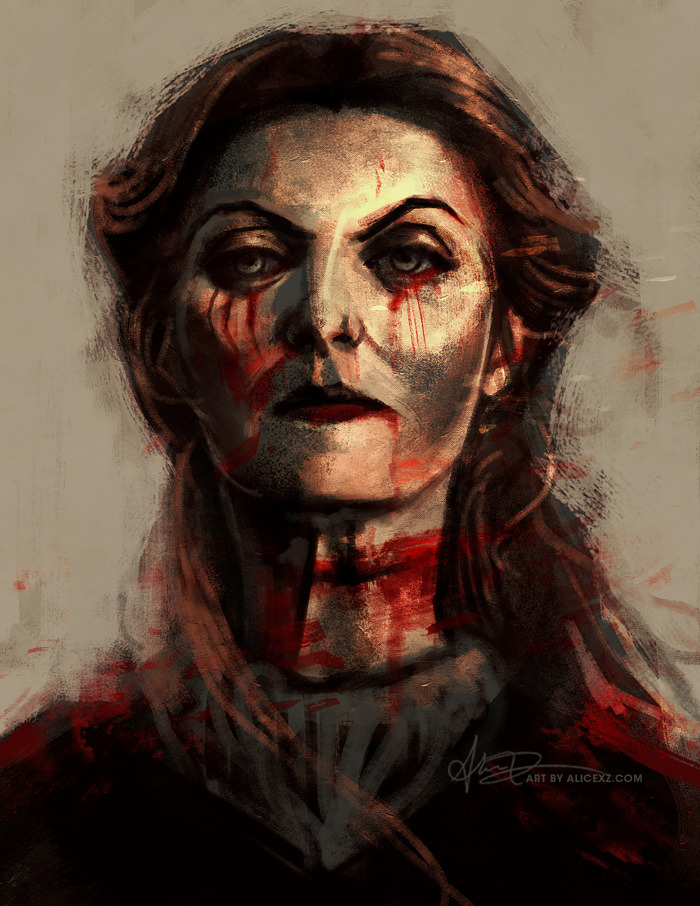
But, despite these characters’ popularity and their compelling narratives, the texts we’ve read so far—Chaucer’s The Man of Law’s Tale and the Encomium Emmae Reginae—don’t lead me to believe that these larger-than-life, openly defiant, openly powerful women were common in the actual medieval era. Instead, I think the characters audiences tend to overlook are the more realistic representations of female power in a medieval patriarchal structure. Particularly Catelyn and Sansa Stark.

Hard to believe there was a time when things didn't suck for the Starks.
In a 2012 interview, George R. R. Martin was asked why he kept coming back to ASOIAF. His response was—shockingly—long-winded, but within it, he discussed Sansa, saying,
“So many of the people dislike her because they are just like her—they cannot understand characters who do not fit into predetermined roles. Women in fantasy are allowed to be strong in only a few ways—evil seductress, tomboy lady knight, etc.—and it frustrates so many readers that Sansa develops her strength not by rejecting her courtesy or her traditional femininity, but my making those things into armor… Once Sansa’s [personal narrative] has been torn down, has been eradicated completely, her only narrative, if you can call it that, is a will to survive. By the end of A Feast for Crows, she’s seeing her world more clearly than almost anyone else, even if she’s basically powerless to do anything about it.”
Now, I wouldn’t say that she’s powerless, as both Emma and Custance were not completely powerless. I argue instead that their defiance can only work within the power structures in which they live. For example, Emma’s contract with Cnut, giving their songs inheritance of his English throne before his elder sons is similar to Catelyn’s working as negotiator for Robb (in his capacity as King of the North) to Renly Baratheon and the Freys. Custance and Sansa also follow similar paths, namely, being sent to marry men without regard to their own will. And they each go through with it as part of their duty, as made evident when Custance (sorrowfully) prepares herself to leave Rome (lines 264-271), and when Sansa is forced into marrying Tyrion. They then both manage to defy the systems in their own ways, without wild disobedience, but rather spirituality and courtesy—Custance remains a Christian, and Sansa refuses to kneel for Tyrion Lannister at their wedding.

Basically, in these kinds of distinctly patriarchal systems, women are bargaining chips, and from a woman’s position in their society, even a royal position, little could be done to change it. And while I, like many others, enjoy the narratives of women who openly defy that positioning, characters like Cersei and Brienne remind me of a quote from American Gangster: “the loudest one in the room is the weakest one in the room.” Because, by claiming their own power through defiance, they make one major mistake: they make noise. And in a world where women are kept quiet, making noise makes them fast targets. On the other hand, those who defy quietly, cleverly, and with courtesy—characters like Emma and Sansa—retain more freedom than their louder counterparts. 

Until they become vengeance-seeking Zombies, anyway.

The Pedestal Woman: The Man of Law's Custance and Nakaba Suzuki's Elizabeth

The two generalized bounds that women have been frequently categorized into within the context of medieval literature -- especially in the 20th century before the upsurge of women's medieval studies of the 1970s and 1980s -- are the "Pedestal" woman of purity and beauty but frequent passivity, and the "Stake" woman associated with wickedness and magic who are frequently active players. Chaucer and his Man of Law tell the tale of Lady Custance, which almost immediately reminded me of heroine Elizabeth Liones from Nakaba Suzuki's "The Seven Deadly Sins". Initially I felt it had to be some shallow level with which I associated them, maybe in their appearance, as they are both said to be pale. Upon further inspection, I found that both fell heavily into the Pedestal half of the dichotomy of women's depictions in story.

Custance

In Chaucer's "Canterbury Tales", the Man of Law recounts the tale of Custance, the epitome of Christian purity and female submission. She is a woman of high rank -- the daughter of the emperor -- but without any true power of her own. She is rarely described physically, but when she is, it emphasizes her paleness and light coloring; most of her descriptions focus on her humility, generosity, and other "Christianly traits". Her tale's focus in terms of her experience as a narrative demonstrates a great deal of personal suffering and traveling the path alone. And while the tale is focused on Custance, she is a passive character; when she is at sea, she is simply existing, and when on land events happen to or around her rather than occurring because of her own direct actions -- whether she is being accused of killing a woman, nearly being sexually assaulted in front of her child, or exiled from the homelands of either of her husbands, only God takes action. And men, but who really cares about them? 

Elizabeth

In Nakaba Suzuki's The Seven Deadly Sins, a neo-medieval story written by a Japanese mangaka, the female character of Elizabeth holds many of the same traits that Custance does. Like Custance, she is the daughter of a royal leader but has no direct influence in politics. She is also very pale, with white hair and skin, and blue eyes -- and while her appearance is much clearer due to the media in which she appears, within both the manga and the show her primary characteristics are emphasized to be her kindness, her honesty, and her selflessness. And within the story itself, Elizabeth is introduced as having traveled alone from the capital whilst being pursued by kidnappers and assailants on her family, much as Custance's harrowing sea travels and trials with being assaulted. Despite this very active role pre-story, Elizabeth takes very little action through the rest of the series: other characters (including a few women) take on the tasks of fighting battles, working jobs, and developing their personalities, while Elizabeth is portrayed as a pure-hearted and beautiful young woman, but is time and again unable to take on an active role within the cast.

While a little surprising -- primarily because The Seven Deadly Sins has some major female characters who aren't bound by the dichotomy like Elizabeth is -- in the end I found that it made a lot of sense for Elizabeth and Custance both to be a part of this Pedestal Woman portrayal because over time, the Pedestal Woman has become an archetype. Characters like the damsel in distress and the pure-hearted heroine have become such a prevalent feature of women's representation in storytelling that even now we tend to fall back on it. By no means do I find this satisfying -- I personally detested much of Elizabeth's characterization solely because of her lack of action -- but now that I understand why Elizabeth- and Custance-type exist, I find it makes them more bearable. 

Women: Empowerment or Degradation?

So far, the readings we have encountered make it apparent that women during the Middle Ages are viewed as inferior to men. Along with other negative connotations and stereotypical roles, women are associated with beauty or physical attractiveness and highly regarded for their traditional family roles as well as religious devotion and virtue.

I’d like to focus on one video game in particular since it does hold some relevant themes of the Middle Ages; Dante’s Inferno. In summary, Dante is a crusader during the Third Crusade under King Richard I. During an attack, Dante is stabbed and defeats Death. As he returns home to Florence, he finds his lover Beatrice Portinari and father brutally murdered. Beatrice's soul appears before Dante and she is then taken by Lucifer. His mission is to save her by enduring eight trials in Hell.

I would like to compare Custance’s character from The Man of Law’s Tale and the character Beatrice in Dante’s Inferno. They share similar qualities- mostly in the way they are portrayed.  Both of these characters are revered for their Christian purity and seen as prizes to be pursued by male suitors. In The Man of Law’s Tale, Custance is dramatically idealized:
“There was never such another as is she,
I pray to God to sustain her in honor.
In her is great beauty, without pride/
In all her deeds virtue is her guide;
Humility has slain in her all tyranny/
Her heart is a true chamber of holiness” (162-167).
This passage makes it obvious of “woman’s difference from man, her otherness” and passiveness through religious undertones (Schinamoff  63).


In Dante’s Inferno, Beatrice is also put on a pedestal and represents Bennett’s and Karra’s definition of woman as “capable of extraordinary good, -the Virgin Mary’” (1). Compared to her lover Dante who has sinned countless times, Beatrice is proclaimed as beautiful, pure, kind and blessed; even her name implies beatific love: the ultimate direct self-communication of God to the individual person (Webster).

 The way these women are portrayed is with the most favorable qualities; humility, beauty, youth, virtue, passivity, and “pale” skinned. This showcases that they are ideal women to be had.  “Gender rules were similarly God- given, and the submission of women to men paralleled the submission of all humanity to God” (Bennett 5). In addition, this also meant submission was an automatic feature that came along with women’s wholesome qualities, and in these two cases these women are also being hyper idolized making them more dissimilar. Custance and Beatrice’s descriptions seem to elevate them and simultaneously degrade them. It may be flattering in a way, but the idealization of their passiveness and beauty can also be disempowering.