Showing posts with label sansa stark. Show all posts

Monday, March 21, 2016

Out for Blood: Reactions to Women Bleeding


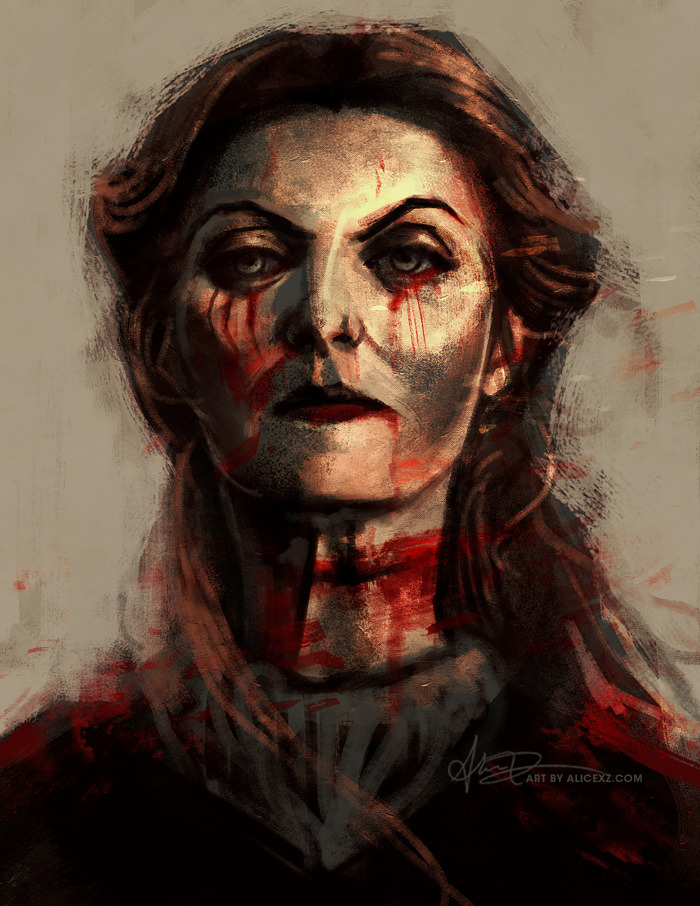
In the show and books, Game of Thrones treats blood as a symbol of a women’s ability to have children, and therefore ability to be married. In the show, Sansa Stark is horrified to wake up to find that she has started her period. She wakes from a nightmare where she is being harassed to find blood all over her sheets. In this scene the focus is on her blood that has stained her sheets instead of the blood on her. She rushes to get a knife to cut out the stain and Shae walks in and immediately starts helping her hide the blood, which they are eventually unsuccessful in doing. Sansa’s blood was the focus of this scene. After, Sansa confesses to Cersei that she did not expect it so messy and Cersei tells her that childbirth is worse. The obsession with Sansa’s “flowering” is connected to her ability now to have children, specifically Joffery’s children, so they can now marry. In this example, a medieval woman bleeds to show her ability to have children. She is scared of her own blood while everyone else was anticipating it. As Sansa is now scared of the king, the thought of having his children is something is desperately avoiding. The same acceptance and usefulness of women’s blood is seen with Dany as she prepares to marry Khal Drogo. She is described as being ready for marriage because “she has had her blood” (34). Again women’s blood is connected to their ability to have children and therefore, in this scenario, their individual worth.


Another example of blood from the show is in the scene between Ygritte and Jon Snow in which Ygritte assures Jon that “girls see more blood than boys.” Here is another reverse to women’s menstruation and childbirth but this time it is in a superior tone. Ygritte portrays women’s almost indifference to blood as a strength they have over men.

From the book A Feast for Crows, Cersei does not talk of blood in menstruation; instead it is something that is showing her weakness. Curse has a dream that she is sitting on the Iron Throne but it is almost attacking her as the sharp edges cut into her skin. The description of the dream is vivid: “blood ran red down her legs, as still teeth gnawed at her buttocks…The more she struggled the more the throne engulfed her, tearing chunks of flesh from her breasts and belly, slicing at her arms and legs until they were slick and red, glistening” (Martin 65-66). Here blood seems to be Cersei’s punishment for wanting to hold a man’s position and gain power. Cersei imitating a man has caused her to bleed and her blood is not praised for what it brings or a sign of strength but rather a sign of her weakness and shortcoming.


For these female characters, the presence of blood takes on several different meanings and can either be an unwelcome sentence or a symbol of their power.

Thursday, February 18, 2016

“There are fights no sword can win”: Catelyn and Sansa Stark as (Better) Representations of Medieval Noblewomen

If there’s anything A Song of Ice and Fire (and Game of Thrones) have, it’s a lot of characters. Enough to justify 25+ page appendices at the end of each book, and infographics across the internet for show-viewers. 

I wonder if GRRM has a wall of his house devoted to keeping track of this stuff.
Thus, both series include a range of female characters (though the narrative treatment of the women arguably doesn’t vary that much), fitting many roles familiar to us as so-called ‘strong female characters’ (I’m setting the critiques of that idea and those portrayals aside for the sake of this post).

Among the women in the series are many fan favorites and favorites-to-hate, like Daenerys Targaryen, Cersei Lannister, Brienne of Tarth, and Arya Stark. Daenerys and Cersei mirror one another in their use of marriage and childbearing to claim power in their own right—Daenerys as khaleesi of what will become her own (small) khalasar, and Cersei becoming Queen Regent over Joffrey, followed by Tommen. Brienne and Arya take the opposing route: rather than using their femininity to work around men, they forego it instead, dressing masculinely and learning skills only taught to men (fighting, swordplay, survival skills, etc.)

Game of Thrones, more like Game of "Who's that again?"

These are all larger-than-life women (and girls) who openly defy their societies in ways we recognize and love today, because the ways they claim agency are familiar tropes to modern audiences. They remind us of the Katniss Everdeens, Hermione Graingers, and Blue Sergeants of the modern book-to-movie machine. Because of the Westerosi and Dothraki societies they inhabit, they may not hold power in the way a man could, but they do hold agency over themselves in ways many of their fellow female characters cannot.

But, despite these characters’ popularity and their compelling narratives, the texts we’ve read so far—Chaucer’s The Man of Law’s Tale and the Encomium Emmae Reginae—don’t lead me to believe that these larger-than-life, openly defiant, openly powerful women were common in the actual medieval era. Instead, I think the characters audiences tend to overlook are the more realistic representations of female power in a medieval patriarchal structure. Particularly Catelyn and Sansa Stark.

Hard to believe there was a time when things didn't suck for the Starks.
In a 2012 interview, George R. R. Martin was asked why he kept coming back to ASOIAF. His response was—shockingly—long-winded, but within it, he discussed Sansa, saying,
“So many of the people dislike her because they are just like her—they cannot understand characters who do not fit into predetermined roles. Women in fantasy are allowed to be strong in only a few ways—evil seductress, tomboy lady knight, etc.—and it frustrates so many readers that Sansa develops her strength not by rejecting her courtesy or her traditional femininity, but my making those things into armor… Once Sansa’s [personal narrative] has been torn down, has been eradicated completely, her only narrative, if you can call it that, is a will to survive. By the end of A Feast for Crows, she’s seeing her world more clearly than almost anyone else, even if she’s basically powerless to do anything about it.”
Now, I wouldn’t say that she’s powerless, as both Emma and Custance were not completely powerless. I argue instead that their defiance can only work within the power structures in which they live. For example, Emma’s contract with Cnut, giving their songs inheritance of his English throne before his elder sons is similar to Catelyn’s working as negotiator for Robb (in his capacity as King of the North) to Renly Baratheon and the Freys. Custance and Sansa also follow similar paths, namely, being sent to marry men without regard to their own will. And they each go through with it as part of their duty, as made evident when Custance (sorrowfully) prepares herself to leave Rome (lines 264-271), and when Sansa is forced into marrying Tyrion. They then both manage to defy the systems in their own ways, without wild disobedience, but rather spirituality and courtesy—Custance remains a Christian, and Sansa refuses to kneel for Tyrion Lannister at their wedding.

Basically, in these kinds of distinctly patriarchal systems, women are bargaining chips, and from a woman’s position in their society, even a royal position, little could be done to change it. And while I, like many others, enjoy the narratives of women who openly defy that positioning, characters like Cersei and Brienne remind me of a quote from American Gangster: “the loudest one in the room is the weakest one in the room.” Because, by claiming their own power through defiance, they make one major mistake: they make noise. And in a world where women are kept quiet, making noise makes them fast targets. On the other hand, those who defy quietly, cleverly, and with courtesy—characters like Emma and Sansa—retain more freedom than their louder counterparts. 

Until they become vengeance-seeking Zombies, anyway.