Thursday, February 18, 2016

Game of Thrones: Gender Roles and the Use of Power through a Medieval Woman


          The amount of authority a woman had depended solely on society.  Power was sorted among two divisions, the public and private sphere.  The public sphere was considered to be the domain of men.  The men had authority over the market, politics, and legal rights and obligations.  Then there was the private or domestic sphere which categorized women, mothers, and families into this group.  Women were considered to be the caretakers of their households and responsible for familial obligations.  Society's goals for women during these times was to please their husbands and children.  With this being said, one may think that men could only attain power. Yes, power was limited for women, but not completely.  It could be attained through certain circumstances, such as inheritance of land or marriage.  This is apparent in George R.R. Martin's A Game of Throne.  In a patriarchal society, Dany is a submissive female character.  However, she finds a way to claim power through marriage. Whether it be self-interest or not, it was the only way.  
          Dany, a  young thirteen year old girl,  is used as a pawn in her brother's power hungry game.  Her brother, Viserys, prepares her to be presented to Khal in hopes of marrying her off.  Indeed, all went well.  Surprisingly, the marriage forms a bridge of independence from the abusive experiences Dany encounters with her brother/guardian.  He was a "waking dragon" who often breathed fire and placed his anger on his younger sister.  He threatens her, he spits out, "Do you want to wake the dragon, do you?" (29).  He tightens her nipple as he evokes fear in her.  She responds obediently with a no "meekly" (29). Once married, throughout the book Dany gains confidence slowly.  Later within the novel her confidence is displayed in her thoughts and actions.  From an obedient and helpless girl under the care of her brother, Dany realizes "that she did not want to listen to any of her brother's complaints" (227).  With her marriage, she has gained power that led her to live a healthier life style. 


“There are fights no sword can win”: Catelyn and Sansa Stark as (Better) Representations of Medieval Noblewomen

If there’s anything A Song of Ice and Fire (and Game of Thrones) have, it’s a lot of characters. Enough to justify 25+ page appendices at the end of each book, and infographics across the internet for show-viewers. 

I wonder if GRRM has a wall of his house devoted to keeping track of this stuff.
Thus, both series include a range of female characters (though the narrative treatment of the women arguably doesn’t vary that much), fitting many roles familiar to us as so-called ‘strong female characters’ (I’m setting the critiques of that idea and those portrayals aside for the sake of this post).

Among the women in the series are many fan favorites and favorites-to-hate, like Daenerys Targaryen, Cersei Lannister, Brienne of Tarth, and Arya Stark. Daenerys and Cersei mirror one another in their use of marriage and childbearing to claim power in their own right—Daenerys as khaleesi of what will become her own (small) khalasar, and Cersei becoming Queen Regent over Joffrey, followed by Tommen. Brienne and Arya take the opposing route: rather than using their femininity to work around men, they forego it instead, dressing masculinely and learning skills only taught to men (fighting, swordplay, survival skills, etc.)

Game of Thrones, more like Game of "Who's that again?"

These are all larger-than-life women (and girls) who openly defy their societies in ways we recognize and love today, because the ways they claim agency are familiar tropes to modern audiences. They remind us of the Katniss Everdeens, Hermione Graingers, and Blue Sergeants of the modern book-to-movie machine. Because of the Westerosi and Dothraki societies they inhabit, they may not hold power in the way a man could, but they do hold agency over themselves in ways many of their fellow female characters cannot.

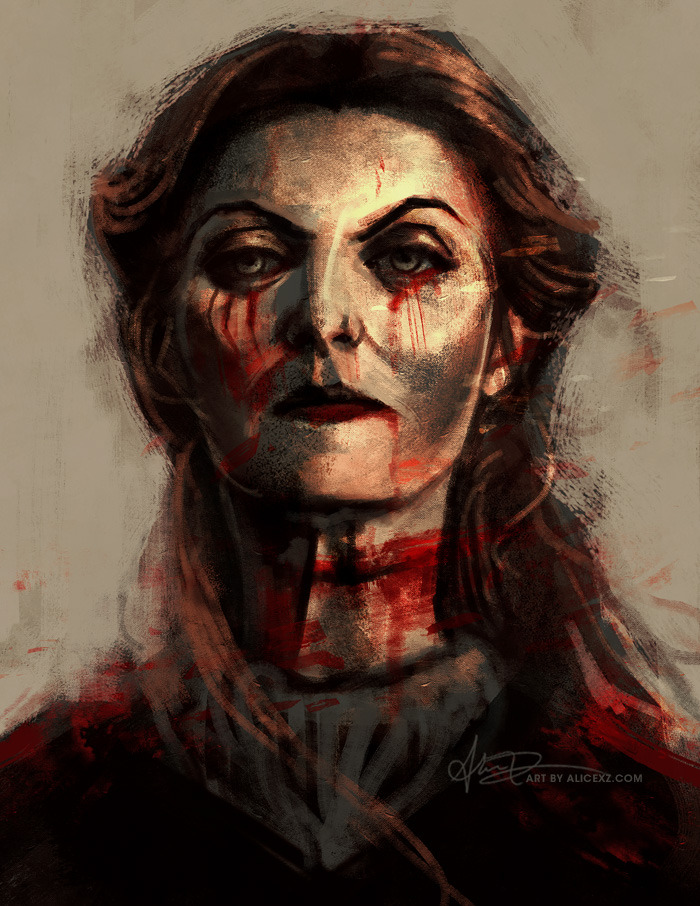
But, despite these characters’ popularity and their compelling narratives, the texts we’ve read so far—Chaucer’s The Man of Law’s Tale and the Encomium Emmae Reginae—don’t lead me to believe that these larger-than-life, openly defiant, openly powerful women were common in the actual medieval era. Instead, I think the characters audiences tend to overlook are the more realistic representations of female power in a medieval patriarchal structure. Particularly Catelyn and Sansa Stark.

Hard to believe there was a time when things didn't suck for the Starks.
In a 2012 interview, George R. R. Martin was asked why he kept coming back to ASOIAF. His response was—shockingly—long-winded, but within it, he discussed Sansa, saying,
“So many of the people dislike her because they are just like her—they cannot understand characters who do not fit into predetermined roles. Women in fantasy are allowed to be strong in only a few ways—evil seductress, tomboy lady knight, etc.—and it frustrates so many readers that Sansa develops her strength not by rejecting her courtesy or her traditional femininity, but my making those things into armor… Once Sansa’s [personal narrative] has been torn down, has been eradicated completely, her only narrative, if you can call it that, is a will to survive. By the end of A Feast for Crows, she’s seeing her world more clearly than almost anyone else, even if she’s basically powerless to do anything about it.”
Now, I wouldn’t say that she’s powerless, as both Emma and Custance were not completely powerless. I argue instead that their defiance can only work within the power structures in which they live. For example, Emma’s contract with Cnut, giving their songs inheritance of his English throne before his elder sons is similar to Catelyn’s working as negotiator for Robb (in his capacity as King of the North) to Renly Baratheon and the Freys. Custance and Sansa also follow similar paths, namely, being sent to marry men without regard to their own will. And they each go through with it as part of their duty, as made evident when Custance (sorrowfully) prepares herself to leave Rome (lines 264-271), and when Sansa is forced into marrying Tyrion. They then both manage to defy the systems in their own ways, without wild disobedience, but rather spirituality and courtesy—Custance remains a Christian, and Sansa refuses to kneel for Tyrion Lannister at their wedding.

Basically, in these kinds of distinctly patriarchal systems, women are bargaining chips, and from a woman’s position in their society, even a royal position, little could be done to change it. And while I, like many others, enjoy the narratives of women who openly defy that positioning, characters like Cersei and Brienne remind me of a quote from American Gangster: “the loudest one in the room is the weakest one in the room.” Because, by claiming their own power through defiance, they make one major mistake: they make noise. And in a world where women are kept quiet, making noise makes them fast targets. On the other hand, those who defy quietly, cleverly, and with courtesy—characters like Emma and Sansa—retain more freedom than their louder counterparts. 

Until they become vengeance-seeking Zombies, anyway.

The Pedestal Woman: The Man of Law's Custance and Nakaba Suzuki's Elizabeth

The two generalized bounds that women have been frequently categorized into within the context of medieval literature -- especially in the 20th century before the upsurge of women's medieval studies of the 1970s and 1980s -- are the "Pedestal" woman of purity and beauty but frequent passivity, and the "Stake" woman associated with wickedness and magic who are frequently active players. Chaucer and his Man of Law tell the tale of Lady Custance, which almost immediately reminded me of heroine Elizabeth Liones from Nakaba Suzuki's "The Seven Deadly Sins". Initially I felt it had to be some shallow level with which I associated them, maybe in their appearance, as they are both said to be pale. Upon further inspection, I found that both fell heavily into the Pedestal half of the dichotomy of women's depictions in story.

Custance

In Chaucer's "Canterbury Tales", the Man of Law recounts the tale of Custance, the epitome of Christian purity and female submission. She is a woman of high rank -- the daughter of the emperor -- but without any true power of her own. She is rarely described physically, but when she is, it emphasizes her paleness and light coloring; most of her descriptions focus on her humility, generosity, and other "Christianly traits". Her tale's focus in terms of her experience as a narrative demonstrates a great deal of personal suffering and traveling the path alone. And while the tale is focused on Custance, she is a passive character; when she is at sea, she is simply existing, and when on land events happen to or around her rather than occurring because of her own direct actions -- whether she is being accused of killing a woman, nearly being sexually assaulted in front of her child, or exiled from the homelands of either of her husbands, only God takes action. And men, but who really cares about them? 

Elizabeth

In Nakaba Suzuki's The Seven Deadly Sins, a neo-medieval story written by a Japanese mangaka, the female character of Elizabeth holds many of the same traits that Custance does. Like Custance, she is the daughter of a royal leader but has no direct influence in politics. She is also very pale, with white hair and skin, and blue eyes -- and while her appearance is much clearer due to the media in which she appears, within both the manga and the show her primary characteristics are emphasized to be her kindness, her honesty, and her selflessness. And within the story itself, Elizabeth is introduced as having traveled alone from the capital whilst being pursued by kidnappers and assailants on her family, much as Custance's harrowing sea travels and trials with being assaulted. Despite this very active role pre-story, Elizabeth takes very little action through the rest of the series: other characters (including a few women) take on the tasks of fighting battles, working jobs, and developing their personalities, while Elizabeth is portrayed as a pure-hearted and beautiful young woman, but is time and again unable to take on an active role within the cast.

While a little surprising -- primarily because The Seven Deadly Sins has some major female characters who aren't bound by the dichotomy like Elizabeth is -- in the end I found that it made a lot of sense for Elizabeth and Custance both to be a part of this Pedestal Woman portrayal because over time, the Pedestal Woman has become an archetype. Characters like the damsel in distress and the pure-hearted heroine have become such a prevalent feature of women's representation in storytelling that even now we tend to fall back on it. By no means do I find this satisfying -- I personally detested much of Elizabeth's characterization solely because of her lack of action -- but now that I understand why Elizabeth- and Custance-type exist, I find it makes them more bearable. 

Women: Empowerment or Degradation?

So far, the readings we have encountered make it apparent that women during the Middle Ages are viewed as inferior to men. Along with other negative connotations and stereotypical roles, women are associated with beauty or physical attractiveness and highly regarded for their traditional family roles as well as religious devotion and virtue.

I’d like to focus on one video game in particular since it does hold some relevant themes of the Middle Ages; Dante’s Inferno. In summary, Dante is a crusader during the Third Crusade under King Richard I. During an attack, Dante is stabbed and defeats Death. As he returns home to Florence, he finds his lover Beatrice Portinari and father brutally murdered. Beatrice's soul appears before Dante and she is then taken by Lucifer. His mission is to save her by enduring eight trials in Hell.

I would like to compare Custance’s character from The Man of Law’s Tale and the character Beatrice in Dante’s Inferno. They share similar qualities- mostly in the way they are portrayed.  Both of these characters are revered for their Christian purity and seen as prizes to be pursued by male suitors. In The Man of Law’s Tale, Custance is dramatically idealized:
“There was never such another as is she,
I pray to God to sustain her in honor.
In her is great beauty, without pride/
In all her deeds virtue is her guide;
Humility has slain in her all tyranny/
Her heart is a true chamber of holiness” (162-167).
This passage makes it obvious of “woman’s difference from man, her otherness” and passiveness through religious undertones (Schinamoff  63).


In Dante’s Inferno, Beatrice is also put on a pedestal and represents Bennett’s and Karra’s definition of woman as “capable of extraordinary good, -the Virgin Mary’” (1). Compared to her lover Dante who has sinned countless times, Beatrice is proclaimed as beautiful, pure, kind and blessed; even her name implies beatific love: the ultimate direct self-communication of God to the individual person (Webster).

 The way these women are portrayed is with the most favorable qualities; humility, beauty, youth, virtue, passivity, and “pale” skinned. This showcases that they are ideal women to be had.  “Gender rules were similarly God- given, and the submission of women to men paralleled the submission of all humanity to God” (Bennett 5). In addition, this also meant submission was an automatic feature that came along with women’s wholesome qualities, and in these two cases these women are also being hyper idolized making them more dissimilar. Custance and Beatrice’s descriptions seem to elevate them and simultaneously degrade them. It may be flattering in a way, but the idealization of their passiveness and beauty can also be disempowering.


Perceived "otherness," Female Agency, and Reversed Gender Roles


While this may be applying a Victorian era viewpoint to the novel, one can assume that marriage was used as a means of creating familiar ties to strengthen political/social status and keep money or power appropriately allocated, which can be seen through the marriage of Khal Drogo and Daenerys Targaryen. As is mentioned in the novel, Targaryens typically married strictly within the family, brother and sister. Yet in an attempt to regain the 7 kingdoms that the Targaryens once ruled, Daenerys’ older brother Viserys marries her to the Dothraki prince to establish allies. And while Dany had little to no say in the final decision, marriage has long been a vehicle for women to assert what little female agency they possessed. Through marriage, a woman could rise in the ranks of class and gain more powerful positions in society. And while this is not discussed in the sections of the book we have read for class, in the GOT HBO adaptation, we know that Dany goes on the use the power she receives through her marriage and of course those dragon eggs, to reclaim the land once ruled by her family. Yet it is interesting in the portrayal of the Dothraki people and Khal as the perceived “other” creates a reversal of standard gender roles, which facilitates Dany’s female agency.

There are multiple mentions throughout Daenerys’ early chapters of her light skin, violet eyes, and long silver hair which starkly contrasts with that of the appearance of Khal Drogo’s with his long braid “as dark as midnight and heavy with scented oil, hung with tiny bells that rang softly as he moved (Martin 30). The contrast of lightness and darkness creates a sense of sin versus purity, which is reminiscent of the familiar savage versus civilized trope which is also represented in the marriage of Constance to the Muslim Sultan in “A Man Of Laws Tale.”

Before Dany and Khal Drogo wed, she is very frightened of him, unable to communicate through a common language; he thus remains a mysterious and unknown threat. On their wedding night, 12 men are killed, as a mark of celebration, which we can assume from Dany’s reaction, was not a widely received notion. On page 28, when speaking of the Dothraki people, Viserys states “ the savages have queer tastes. Boys, horses, sheep…” and while we discussed in class that there was no concept of homosexuality during the time, it's implied here that was a behavior different from the “norm.” The Dothraki in this initial description seem to be barbarous and animalistic, lesser beings to that of the Targaryens, which creates a sense of otherness. However, after the wedding ceremony, when the two are to consummate the marriage, Khal reveals a more affectionate side, and his description is changed to features that are seemingly more female, with his long flowing hair and gentle caresses.

To make a long something that needs more explanation short, by portraying Khal Drogo as first barbarous and beastly and then effeminate: typical factors commonly used for subordinating “others,” Daenerys asserts her dominance and finds female agency through the power of marriage.


New Day, Same Problems

Both Custance from Chaucer’s Canterbury Tales and Constance from BBC’s Man of Law’s Tale face many of the issues common among other medieval women. They are married off to a man they don’t know, they become mothers in need of being saved, and they must deal with their evil mother-in-laws, but in the end love conquers all.


In Chaucer’s original tale, Custance is married off to a Muslim Sultan by her father, the emperor of Rome only to have her new husband killed by his own mother who is angry because her son converted to Christianity. The mother then sends Custance adrift in a boat with no rudder. Poor Custance floats around for years before she comes ashore in Northumberland. She is given shelter by a constable and his wife Hermengyld. Shortly after the knight comes to kill Hermengyld and frame Custance. When the Constable returns with Alla, the investigate the murder and accuse the knight who is struck dead. Soon after Custance and Alla marry. Custance goes through many more hard times including Alla’s mother sending a fake letter from Alla saying that Custance and their unborn son Mauricius are banished. Eventually things work out: Alla kills his mother and returns to Rome to meet Custance, they move back to England and Alla dies, and Custance returns to Rome to be with her father and her son eventually becomes the next emperor of Rome.


Though Custance and Constance have different starts, they both arrive in England scared, afraid, and without anyone to turn to. Both young women find themselves in a constant state of needing to be rescued; a perpetual damsel in distress. Each time things start to turn up, someone else comes in and wrecks their lives. When they find a nurturing mother figure (Hermengyld/Nicky) she is soon killed. In Constance’s case, Nicky is killed by Terry, an obsessed young man who is trying to rape Constance. In both cases our young protagonist is rescued by a young man who has good intentions, but their efforts are both foiled by their own mothers who are not in favor of the relationships.

The tales have two slightly different endings. Custance loses her husband, but ends back up with her father so that her son might continue in his grandfather’s footsteps as emperor of Rome while Constance’s story ends when she reunites with her husband in Africa. However, in each case we are still left with the message that love, specifically that between a man and a women, is the ultimate goal.

Sex Slaves in the Middle Ages

            Thisshort article from Tenth Medieval, a wordpress blog, covers the idea of medieval sex slaves, mostly of the female variety.
They state that is most depictions of slavery, we often draw the conclusion that women sold into slavery were usually exploited for sex, and that it was a more than common occurrence. However, the blogger states that this idea is a bit contrived, considering that the only real record of it is from penitentials setting penances for it, which would mean that it was considered a sin. The blogger states that they are not trying to dispute that it ever happened, but rather they are trying to say that we have limited knowledge on actual occurrences of it happening, which is further narrowed by the fact that we assume that any woman under the power of a man is going to be exploited sexually.
I do not share the sentiment, honestly. Of course male slave owners would sexually abuse their female slaves, because they were seen as little more than property. I’m not saying it happened all the time, but it had to at a frequent enough rate for the stereotype to have been created.
We all know that sex is a massively valuable commodity, and has been for as long as humans have been able to keep records. From this it is fair to infer that if one owns the life of another, they are going to use that to the fullest extent. Even Tomas Jefferson had sex with his slaves, and his face is on currency that we use today.
I’m not trying to underplay the reality of the situation, but come one. It happened. It had to. Sadly, that’s just how things work. Still, some of the same principles are present today in the male over female power relationship. Women in the military are sometimes raped by their commanding officers, but we rarely hear about it happening. And maybe the blogger is right when they say that just because we know it happened doesn’t mean it happened often, but the fact remains that if it happened, it didn’t happen just once.
We’ve seen women exploited for their sexual favors throughout history, and today is no exception, but I’ll stay away from that for now. As the blogger states, a slave was nothing more than a beast of burden, no different from working livestock except that they had the same biology as their owners. It is no secret that sometimes livestock owners would get a little steamy with their livestock, and, I mean, I don’t quite understand the appeal, but to each their own I guess. Anyways, if someone who owned slaves and animals would not hesitate to get romantic with a goat, pig, ox, mule, or what have you, of course they’re going to get down with a human that they own entirely, and is pretty much equal to a head of livestock. Now, I’m not sure which is more deplorable, but at least one makes a tad bit more sense than the other. Again, not trying to diminish the seriousness of it, I’m just saying that it makes sense.

So, in short, all we really know is that, yeah, sometimes male slave owners would have sex (consensual or not) with their female slaves. Hell, who’s to say that the role was never reversed, or that slave owners would have sex with slaves of the same gender? That’s up for speculation, but the former is not. It happened, but we shouldn’t assume that it happened in all cases, because in all likeliness, it didn’t.